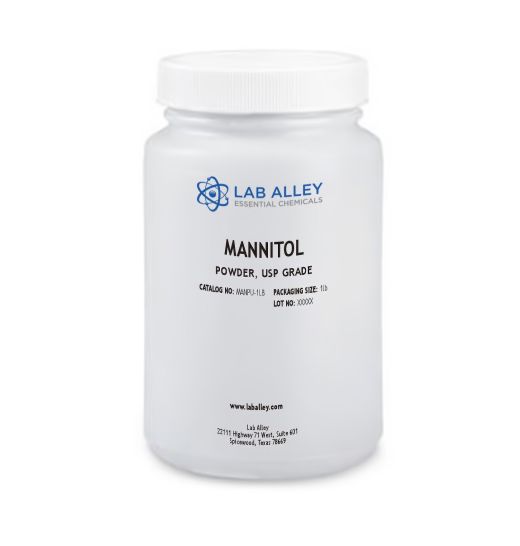
Mannitol, also known as D-mannitol, Mannite, and Osmitrol, has the chemical formula C6H14O6. It appears as a white crystalline powder or free-flowing granules with no odor. It possesses a sweet taste and is slightly soluble in Water at ambient conditions. It is produced on a commercial scale by the catalytic or electrolytic reduction of certain monosaccharides such as Mannose and Glucose.
The ACS grade is generally equivalent to the reagent grade and is acceptable for use in analytical applications and research laboratories. Lab Alley’s premium quality Mannitol, ACS Reagent Grade complies with the American Chemical Society (ACS) and is highly recommended for achieving reliable and repeatable results in research/biochemical labs.
Competitive pricing and well-stocked US-based inventory.
Fast 1-2 business days shipping, including hazmat transport.
Exceptional customer service and chemical technical support.
Delivery on budget, on time, every time.
Product Information
More Information
CAS
64-65-8
Synonyms
D-mannitol, Mannite, and Osmitrol
Assay
97.0 – 102.0 %
PubChem ID
182.17
Grade
USP Grade
Physical form
Solid
Appearance
White
Odor
Odorless
Melting point
165 - 170 °C
Boiling Point
295 °C / 563 °F
Solubility
Partially soluble
Molecular formula
C6H14O6
Molecular weight
182.17
Autoship Available
Yes
Chloride (Cl)
<1 ppm
Lead (Pb)
<0.5 ppm
Loss on drying
≤ 0.5%
Microbial limit
TAMC ≤ 103 CFU/g
Reducing Sugars
≤ 0.1%
Sulfate (SO4)
<1 ppm
Titrabale acid
0.0008 meq/g
Reviews
Safety and Shipping
\
Mannitol’s safety has been reviewed and confirmed by health authorities around the world, including the World Health Organization, the European Union, and the countries Australia, Canada and Japan. The U.S. Food and Drug Administration (FDA) also recognizes mannitol as safe.
\
Symptoms of exposure to Mannitol include nausea, vomiting, headache, chills, chest pain and pulmonary edema. It may cause irritation of the skin, eyes and respiratory tract. Other symptoms may include lethargy, confusion, heart failure and death. Exposure has caused an electrolyte and fluid imbalance, hypersensitivity reactions, diarrhea, thirst, fever, tachycardia, hyponatremia, urinary retention, dehydration, blurred vision, convulsions, urticaria, hypotension and hypertension. It has also caused hyperglycemia and glycosuria. Coughing may result from inhalation. Ingestion may cause gastric irritation. Skin contact may cause discoloration of sensitive skin. Eye contact may cause redness and pain. Intravenous use has led to blood pressure elevation and bladder tubule changes. ACUTE/CHRONIC HAZARDS: This compound may cause irritation of the skin, eyes and respiratory tract. When heated to decomposition it emits acrid smoke and toxic fumes of carbon monoxide and carbon dioxide.
\
Business Support
Built for Business.
At Lab Alley, we simplify procurement with custom quotes, credit
applications, tax exemptions, and fulfillment support, ensuring on-budget, on-time delivery - your
success is our priority. Create or sign into your business account now!
Apply for Credit
A Lab Alley credit account streamlines
purchasing for your business. Our Customer Success Team is available to help you
through every step of the process.
This chemical will only be shipped to addresses that are:
Businesses
Schools and Universities
Laboratories
If you use a residential address during checkout, we will automatically remove this item from your order prior to shipping.
If your order includes more than 1 lb of mercury, it must be shipped to a commercial address, lab, or school.
Please note that we’re unable to ship mercury—of any amount—to apartments or shipping/parcel stores.
Ineligible orders will be automatically canceled.
If you are purchasing SDA in 5 gallons or more, you are required to provide a TTB permit showing how much of the product you are allowed to purchase per year. Please email your TTB permit to customercare@laballey and include your Order Number.